

The Case for Going to the Source
Reading Literature Like a Professor No. 2

I am happy to report that in the short time I have been teaching myself how to read literature more thoughtfully, it has paid more dividends than I would have imagined so early on.
I want to talk about chapter four of How to Read Literature Like a Professor, but I will begin with a small full-circle moment I experienced while reading that made me feel like an absolute genius. Please allow me the delusion.
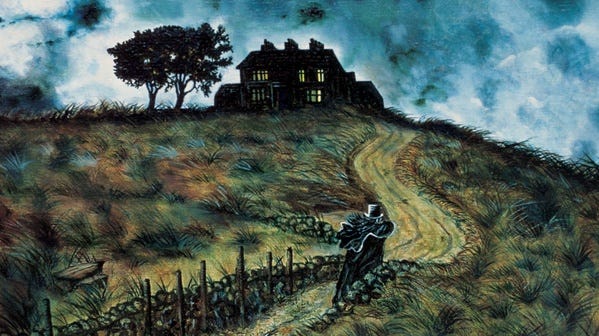
I was about forty pages into Wuthering Heights when a sense of familiarity came over me that I did not have a name for yet. A visitor named Mr. Lockwood arrives at and takes up residence in Thrushcross Grange, where he meets his landlord, Mr. Heathcliff, who lives in a manor called Wuthering Heights, a home that becomes almost a character in its own right, bearing the signs of a disturbing and unsettling history of a toxic and destructive union. As I was reading, I kept thinking: I have been here before. Not literally, and not in any other Brontë novel, but in the structural sense, in the way this setup felt familiar even though I was encountering it for the first time. I could think of at least a handful of stories where something similar unfolds, and though each one is uniquely executed, they tend to arrive in similar places. I did not have a name for what I was noticing.
Then I read chapter four, and I learned that there is one, and also that I am not the first person on earth to make this kind of connection, despite how genuinely groundbreaking it felt in the moment.
What Intertextuality Is
If you have ever found yourself drawing parallels between stories, noticing a familiar thread running through different films or books or shows without being able to articulate exactly why they feel related, what you are likely encountering is what Thomas C. Foster calls intertextuality. The concept is this: much of what we read is not original in the way we tend to assume. It is a product of writers working within a tradition, consciously or not, drawing from the same small pool of source texts that have been so thoroughly absorbed into our culture that they now function almost like a shared grammar. This is why so many of the stories we love have clear parallels with biblical narratives, Shakespearean plays, Greek mythology, or the old fairy tales. This is even more satisfying considering I just finished reading my second Shakespearean play with my children, in our homeschool and thoroughly enjoyed it. I’m really excited to share this information with them!
Foster’s argument, and I find it completely persuasive, is that once you know what those source texts are and what they contain, you will never read the same way again. You will start recognizing the grammar everywhere, in places you would not have thought to look, in stories you have already read and loved and now get to encounter differently.
Why This Makes Such a Strong Case for Reading the Classics
My immediate reaction when I understood what Foster was describing was not intimidation, which surprised me, because the classics have historically felt like a category of thing I was not sure I had earned the right to approach. My reaction was encouragement, and I want to try to explain why, because I think it matters for all of us who came to this kind of reading later than we might have liked.
If intertextuality is real, and the evidence that it is everywhere once you start looking, then reading the source texts is not an act of self-improvement in the vague, aspirational sense. It is one of the most practical things you can do for your development as a reader, because every time you go to the source, you gain the ability to see what every subsequent story that drew from it was actually doing.
Reading Wuthering Heights without knowing much about the Gothic tradition or the Romantic movement or the source texts those movements were drawing from is still a rich experience, because Emily Bronte is a remarkable writer and the novel works on its own terms. But reading it while knowing something about those conversations means that when Heathcliff appears, you are not just meeting a character. You are meeting an archetype that carries the weight of every story that has ever been told about a man shaped by circumstances into something that could not be fully contained, and that weight is part of what Bronte intended. She was working with that tradition, and I think what made her story unique is that she was working against it at the same time. Knowing that makes me want to reread it, and appreciate her storytelling even more!
What Happens to You as a Reader
The thing that has most surprised me about this work is what it does retroactively. I expected that learning to read more carefully would improve my experience of future books, and it has, but I did not anticipate how much it would change my relationship to books I had already read, movies I had already watched, things I thought I had already understood. Once you have the concept of intertextuality, you cannot help applying it everywhere, and everywhere you apply it, something new is revealed.
This is what I mean when I say that reading the source texts makes you a better reader across the board. You become more attuned to what a story is doing beneath the surface of what it appears to be doing. You become better at asking not just what happens, but why this particular shape and why this particular structure. And because the source texts are dealing with the things that human beings have always dealt with, which is to say loss and longing and the desire for justice and the fear of being known and the question of what we owe each other, you also come away from them with a fuller understanding of the world and of the people you share it with. Is that not mind blowing??
A couple more things…
If you have not read How to Read Literature Like a Professor yet, I want to encourage you to start there before you do anything else, because it is not a difficult book, and it is approachable and genuinely fun, and it will reframe everything you read after it in the best possible way.
And if you have been hesitating to pick up one of the source texts because you were not sure you were ready, I want to tell you that the discomfort you might feel at the start is not a sign that you should stop. In fact, expect the discomfort and welcome it (I’m right there with you!)
I would love to know in the comments: have you ever had your own version of my Wuthering Heights moment, where you recognized a pattern in something you were reading before you had a name for it? And if so, what were you reading?